
There is a persistent myth among people new to manufacturing that a casting comes out of the mold looking like the finished part. In reality, what emerges from a sand mold or die is closer to a rough draft. It still has chunks of hardened metal attached where the risers and gates fed it, flash squeezed out along the parting lines, sand clinging to its surfaces, and burrs and rough spots scattered across nearly every feature. The transformation from that raw shape to a clean, functional component is a whole discipline of its own, and it is called aluminum finishing. It is one of the least glamorous stages of metalcasting, and one of the most important.
If you are specifying cast parts, buying them, or designing them, it helps to understand what actually happens after shakeout. Not because you need to run a grinder yourself, but because finishing decisions affect cost, lead time, coating performance, and even part strength. Here is a walkthrough of what post-cast finishing involves and why none of it is optional.
What Comes Out of the Mold
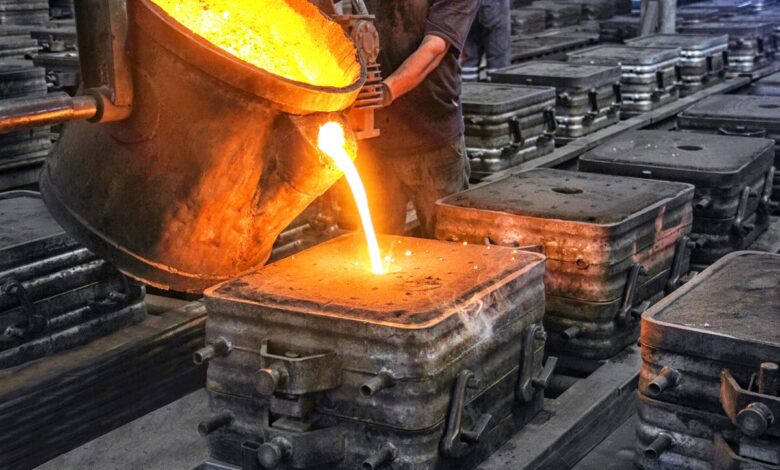
To understand why finishing is necessary, you first have to picture the raw casting. Molten aluminum does not get poured directly into a cavity shaped like your part. It gets poured into a gating system, a network of channels that guides the metal into the mold cavity, controls how it fills, and feeds the part with extra metal as it shrinks during solidification. Risers act as reservoirs. Vents let gases escape. All of that hardware becomes solid metal attached to your part the moment the pour finishes.
Once the mold is broken away, the casting looks like a metal sculpture of a part with extra limbs. Those limbs get cut or knocked off, but the areas where they attached leave stubs, bumps, and rough patches. On top of that, the molding process itself leaves evidence. Sand casting produces a surface texture that reflects the sand grains. Metal seeps into the seam between mold halves and forms thin fins of flash. Cores leave burrs where they were supported. Nothing about this is a defect. It is simply what cast metal looks like before someone cleans it up.
Step One: Gate and Riser Removal
The first task in finishing is removing the gating system and risers. Depending on the size of the casting and the alloy, this might mean breaking them off with a hammer, sawing them, or cutting with torches or abrasive wheels. For larger parts, this is genuinely heavy work. A gating system on a big vehicle component can weigh a meaningful fraction of the casting itself.
The goal is to remove the appendages without damaging the part, and the skill is in getting close without gouging. Whatever stub remains after removal has to be ground down in the next step, so sloppy cutoff work just creates more grinding later.
Step Two: Grinding and Deburring
Grinding is where the casting starts to look like a part. Technicians use handheld and stationary grinders, files, and abrasive tools to remove the stubs left by gates and risers, grind away flash along parting lines, and knock down burrs around core prints and machined features.
This stage matters more than it might seem. Edges that are left ragged can interfere with how the part sits in a fixture, how it mates with other components, and how it handles in assembly. A burr on a bolt-hole flange can keep a fastener from seating. A lump of leftover gate on a sealing surface can scrap the part at final inspection. Grinding is also where edge condition gets controlled. A crisp, consistent edge is often a functional requirement, not a cosmetic preference.
Good grinding is slow, careful work, and it is one of the places where an experienced finishing department earns its keep. Grind too little and the part still carries evidence of the casting process. Grind too aggressively and you cut into good metal, changing dimensions or thinning a wall.
Step Three: Cleaning and Surface Smoothing
After grinding, the casting is covered in dust, filings, and residue from the mold and the grinding itself. Cleaning removes all of it. Depending on the requirements, this can be as simple as brushing and wiping, or it can involve washing processes that leave the surface free of oils and particulates.
For parts that need a smooth or attractive surface, buffing and polishing come next. This is not just about shine. A smooth surface is easier to keep clean, which matters in food equipment, medical devices, and electronics housings where dirt and contamination are real concerns. Smooth surfaces also inspect better, because surface texture can hide defects like small porosity or cold shuts from a visual check.
Step Four: Shot Blasting
Shot blasting is one of the most common finishing operations for cast aluminum, and it does several jobs at once. The process hurls small steel or ceramic media at the casting surface, which knocks out any remaining sand, removes minor surface imperfections, and leaves a uniform, matte texture across the whole part.
That uniform texture is more valuable than it sounds. First, it gives downstream processes something to hold onto. Paint, powder coat, and other coatings adhere far better to a slightly textured, freshly blasted surface than to a smooth or contaminated one. Many coating failures trace back to skipping this step. Second, the media impact actually works the surface of the metal, inducing compressive stress in the skin of the part. That compressive layer can modestly improve resistance to cracking and fatigue. So a process most people think of as cosmetic cleanup quietly makes the part more durable.
Finishing and the Rest of the Process Chain
Post-cast finishing does not happen in isolation. It sits between casting and heat treatment on one side and machining, coating, or assembly on the other, and the sequence matters.
For heat-treated castings, finishing usually follows the heat treat, since quenching and aging can leave their own distortion and scale that needs attention. For parts that get machined, the finishing department prepares surfaces so that machining fixtures can locate and clamp them properly. A casting with a lump of gate stub where the fixture should sit is a machining problem waiting to happen. And for parts that get painted or powder coated, the surface condition after finishing determines whether the coating stays on for years or peels off in the first winter.
This is also why communication between the buyer and the foundry about finishing requirements is worth the effort. “As-cast” surface, ground finish, blasted finish, and buffed finish are all different levels of work with different costs. If a surface will be machined anyway, there is no point paying for it to be polished. If it will be powder coated, it needs the blast texture. Specifying the right finish for each surface saves money and avoids surprises.
Quality Checks Along the Way
Finishing is where a lot of quality problems either get caught or get created, so reputable shops inspect throughout the process rather than only at the end. Technicians check that gates are removed cleanly, that grinding has not cut into critical dimensions, that surfaces meet the specified texture, and that nothing was missed. For industries with strict requirements, like medical and defense, those inspection points are documented and audited.
Buyers can ask a supplier how finishing quality is verified. The answer tells you a lot about the shop.
The Bottom Line
A casting is not a finished part. It is raw material with potential, and the finishing department is what turns it into something that fits, seals, coats properly, and lasts. Gate removal, grinding, cleaning, buffing, and shot blasting each solve a specific problem left behind by the casting process, and skipping any of them just moves the problem downstream to machining, coating, or your customer’s assembly line. When you are evaluating casting suppliers or planning a project, treat finishing as a core capability rather than an afterthought. The parts that arrive clean, consistent, and ready for the next operation are the ones that came from a shop that takes the unglamorous work seriously.


